
Contents▾
- Nizhny Novgorod in summer: when to go and which month to choose
- The Kremlin, Chkalov Staircase, and the Upper Volga Embankment
- The Strelka, Nizhny Novgorod Fair, and views of the confluence of the rivers
- Summer walks in the centre: Bolshaya Pokrovskaya, Rozhdestvenskaya, and Ilyinskaya
- What to see nearby in summer: Pechersky Monastery, the cable car, and the Volga banks
- What to take with you and how much time to allow for the trip
- Where to stay
- Final thoughts: who will enjoy Nizhny in summer
<p><strong>Nizhny Novgorod in summer</strong> is appealing because the city opens up not only through its museums and Kremlin walls, but also through long walks along the upper bank of the Volga, descents to the Oka, and evening views from the Strelka. If you are planning a summer holiday in Nizhny Novgorod, it is better to allow for more than one day: the city has a different rhythm in the morning, during the day, and at sunset, and the strongest impressions here are often connected precisely with panoramic views and walking routes.</p><p>Below is when to go to Nizhny Novgorod, what to see in July and August, where to go in the heat, and what to take with you so that walks around this city on high riverbanks do not turn into a forced march up and down staircases.</p>
Nizhny Novgorod in summer: when to go and which month to choose
The best time for Nizhny Novgorod is the period when you can walk a lot and stay on the embankments for a long time without needing a windbreaker over everything. At the beginning of summer the city is green and not yet so overheated, in July it looks at its most postcard-perfect, and Nizhny Novgorod in August appeals to those who like a calmer rhythm and softer evening light.
If choosing between the months, I would use this guide:
- June is convenient for long walks around the Kremlin, the Upper Volga Embankment, and the slopes, when the trees are already full and the heat is usually easier to handle.
- Nizhny Novgorod in July means long daylight hours, good views of the Volga and the Oka, and lively city life on the central streets; the downside is that open viewing platforms heat up strongly at midday.
- August is comfortable for those who want to combine the centre, museums, and trips out on the water without the feeling of peak summer pressure.
The main thing to keep in mind is that Nizhny stands on significant changes in elevation. On a map, a route may look short, but on the ground it suddenly gains staircases, descents, and long stretches in the sun. So, answering the question of when to go to Nizhny Novgorod, I would say this: in any summer month, if you are ready to plan your walks for the morning and evening.
The Kremlin, Chkalov Staircase, and the Upper Volga Embankment
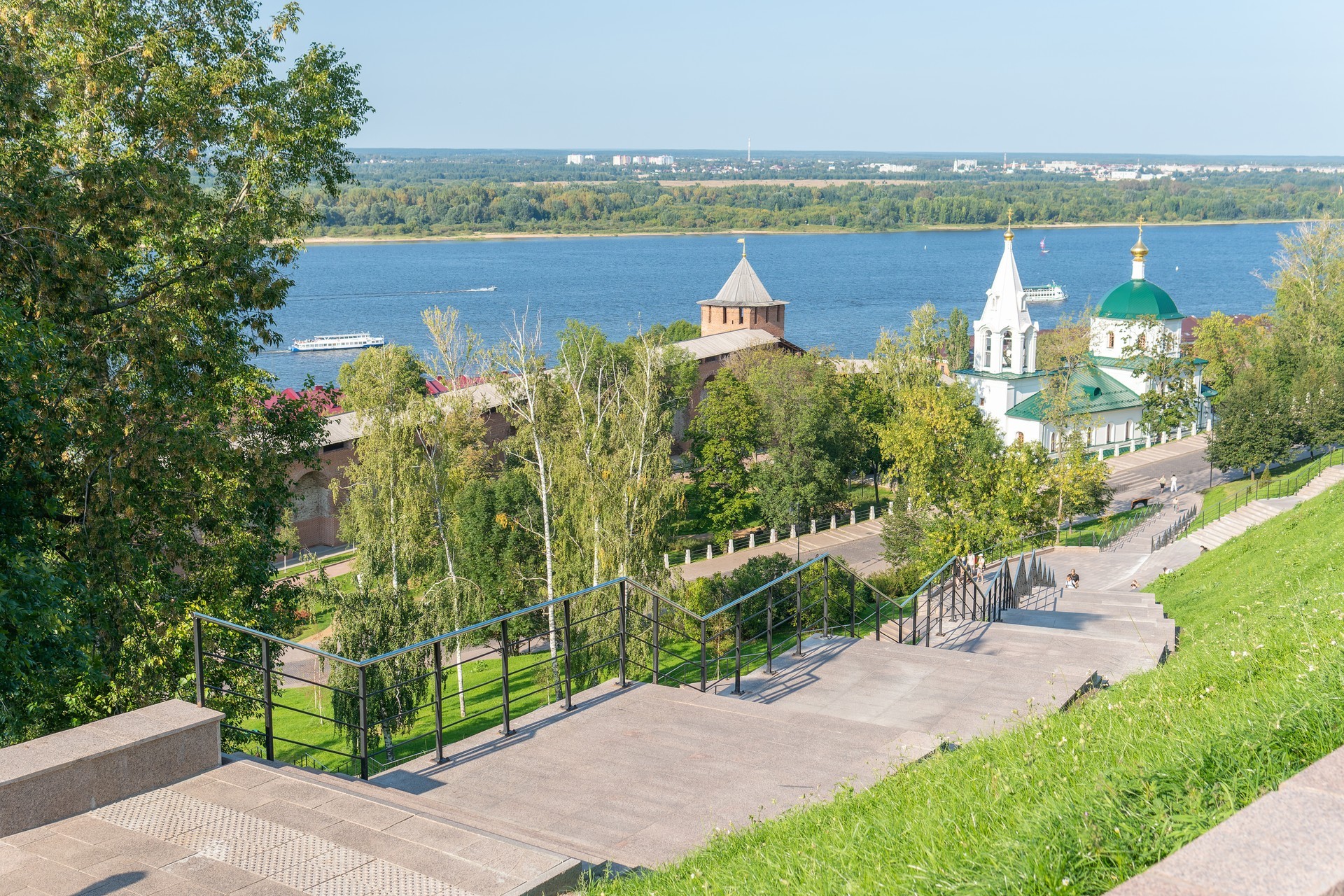
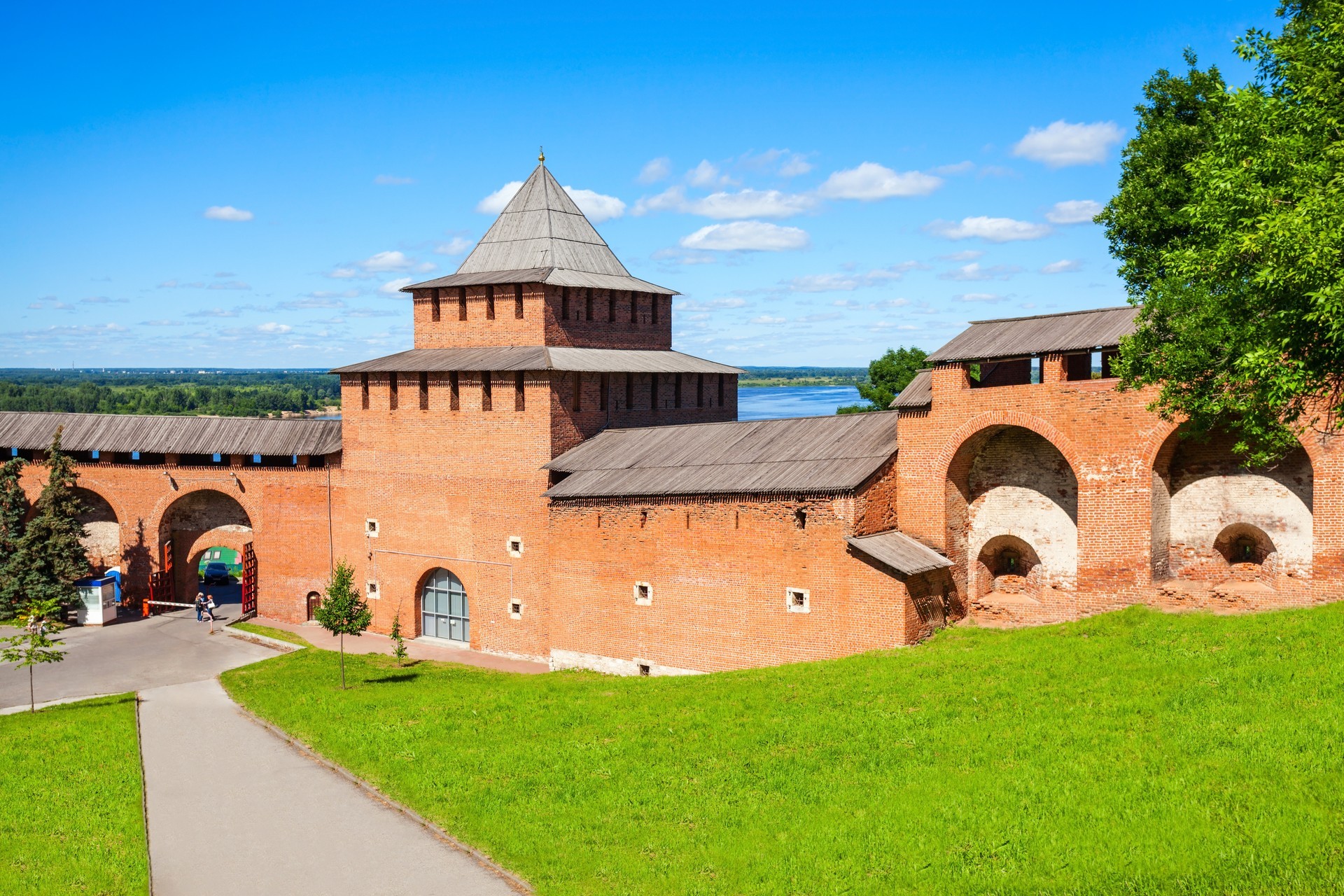
I would build a first summer route around the upper part of the city. The Nizhny Novgorod Kremlin is not only walls and towers, but also a convenient point from which to understand the city’s relief: from here you can clearly feel how Nizhny is spread along the high bank. The city itself was founded in 1221 as a frontier fortress, and the Kremlin silhouette still shapes the centre of any walk.
From the Kremlin it is easy to head to the Chkalov Staircase. In summer it is better not to storm it at midday: the sun on the open slope can be harsh. It is much more pleasant to go down in the morning or closer to evening, when the shadows appear and the Volga is easier to see. Even if you do not cover the whole change in height in one go, the view of the river and the Volga bank is worth this detour.
After that, it makes sense to continue along the Upper Volga Embankment. This is one of the best walking lines in the city: what matters here is not individual points but the rhythm itself - mansions, trees, wind off the water, and the panorama of the Volga constantly beside you. If time is short, it is precisely the combination of “Kremlin - staircase - Upper Volga Embankment” that gives the clearest answer to why you should come to Nizhny in summer.
For an evening walk, you can add the Fedorovsky Embankment. It has a different character: not the ceremonial Volga facade, but views of the lower part of the city, the Oka, and the bridges. At sunset, the changes in elevation that make Nizhny unlike a “flat” city for walking are especially visible here.
The Strelka, Nizhny Novgorod Fair, and views of the confluence of the rivers
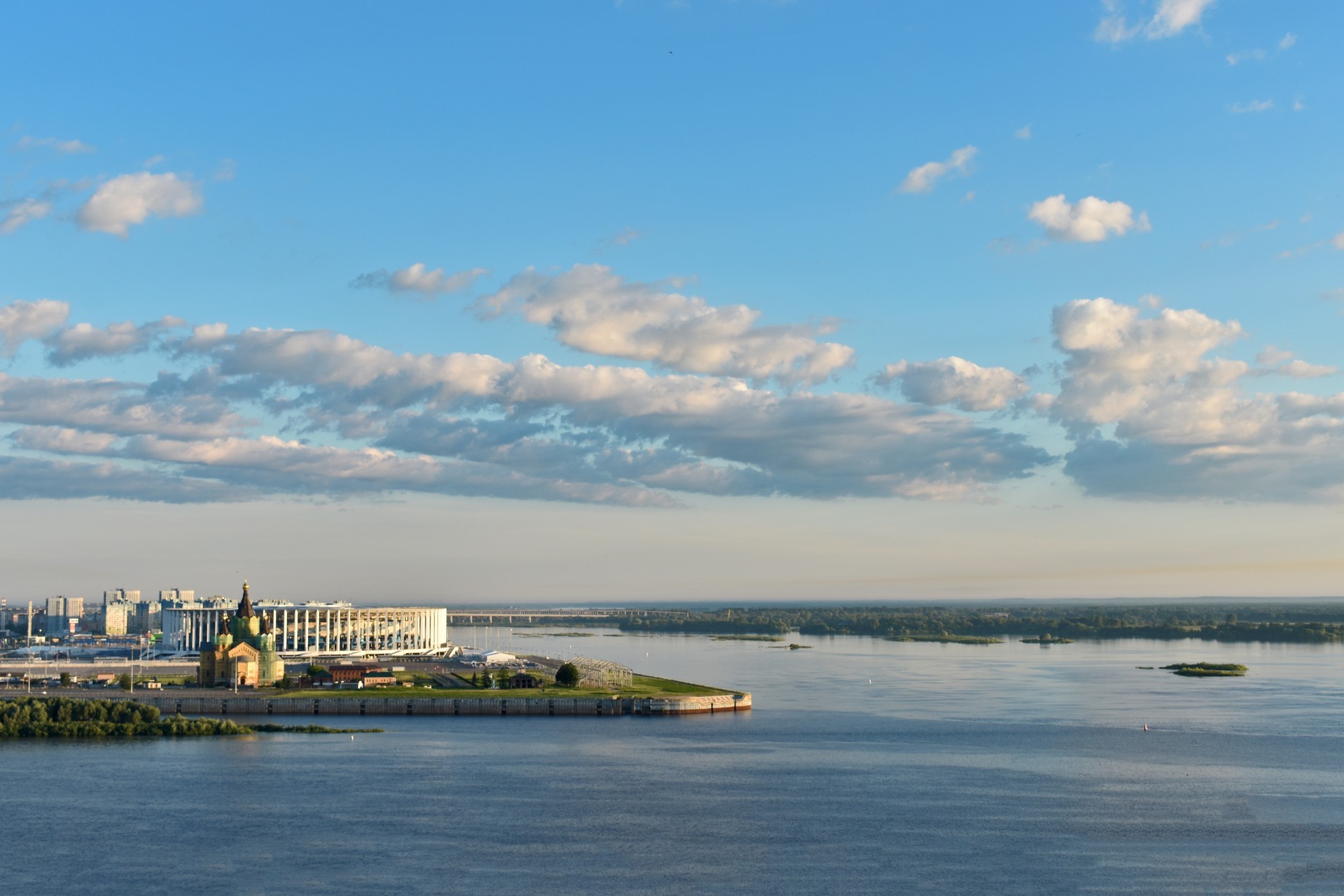
If the upper city is about slopes and long-distance panoramas, then the Strelka area provides Nizhny’s main natural theme. This is exactly where the Oka and the Volga meet - one of the city’s most recognisable views. On a map the point seems obvious, but on the ground what is interesting is not only the confluence itself, but also how the scale changes: wide water, open sky, and a completely different, more spacious Nizhny.
It is convenient to combine the Strelka with a walk around the Nizhny Novgorod Fair. This is an important layer of the city’s history: not fortress-related and not monastic, but commercial, Volga-oriented, with the feel of a major river hub. The area is best explored slowly, with access to the water and pauses for views in different directions - towards the Oka, the Volga, and the upper bank.
In summer I would advise coming here either in the morning, when there are fewer people and the light is softer, or closer to evening. On a hot day, the open spaces by the water do not always help: in some places there is little shade, and the distances between points are greater than they seem. But for photography, an unhurried walk, and a sense of the city’s river scale, the Strelka area is better suited than many central streets.
If you want to link the walk into one route, you can do it like this: start in the fair area, walk to the Strelka, then move on to the viewing points on the upper bank. This makes it especially clear that Nizhny Novgorod stands on the banks of the Oka where it flows into the Volga and is in many ways built around this confluence.
Summer walks in the centre: Bolshaya Pokrovskaya, Rozhdestvenskaya, and Ilyinskaya
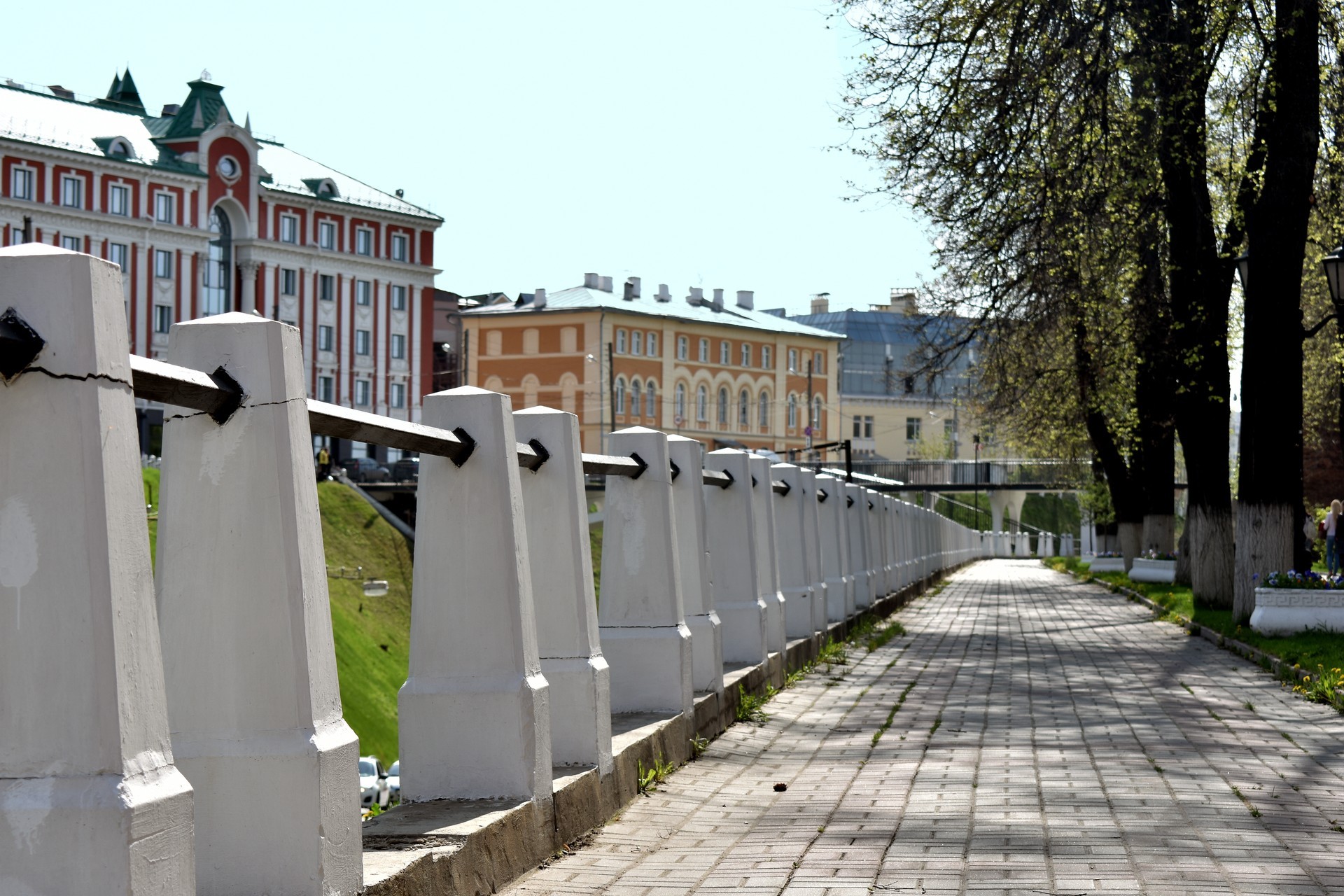
For a day without major crossings between the banks, a central city route along the streets works best. Bolshaya Pokrovskaya is the walking axis with street life, musicians, and a dense flow of people. In summer it is best to come here either in the morning, while the city is only just waking up, or in the evening, when the heat subsides and the street becomes noticeably livelier.
Rozhdestvenskaya Street has a completely different mood. It runs closer to the lower part of the centre, and here merchant Nizhny is felt more strongly: dense historic development, churches, a more intimate scale, and closeness to the water. If you love a city not for its “ceremonial facade” but for its texture, Rozhdestvenskaya is usually more memorable.
Another underrated summer walk is Ilyinskaya Street and the adjoining quarters. There is less of a tourist scene there and more of the feeling of the old city, where the houses themselves, the relief, and the transitions between streets are what matter. This route is good for those who have already seen the main views and want to understand Nizhny more deeply, without rush and without a compulsory checklist.
In summer, it is convenient to include the Russian Museum of Photography and the A. M. Gorky State Museum in a walk: they work well as stops in the middle of a hot day, when you want to get away from the open embankments for a while. And if you need air and shade, you can walk to Aleksandrovsky Garden - an old city park on the Volga slope, where it is pleasant to rest before the next part of the route.
What to see nearby in summer: Pechersky Monastery, the cable car, and the Volga banks
Once the centre has already been covered, summer Nizhny becomes interesting through places a little outside the standard circle. The Ascension Pechersky Monastery stands farther down the Volga from the historic centre and shows well how the high bank, ancient monastic ensembles, and the broad river coexist in the city. It is better to go here without rushing: the place requires at least an hour for an unhurried visit and scenic stops.
Another characteristic summer experience is the cable car across the Volga towards Bor. Even if you do not set yourself the goal of spending the day on the other bank, the ride itself gives a rare perspective on the water, the city, and the Volga spaces. This is one of those cases when transport also works as a viewing platform.
If you want a calmer walk, without the dense city centre, choose the Volga slopes and green sections along the embankments. In hot weather, it is better to avoid the idea of “seeing everything on foot in one day”: Nizhny is beautiful precisely when you alternate viewing points, streets, and pauses in the shade. In this city, you do not need to keep running to the next sight - it is worth lingering on the bank, watching how the light changes over the Volga and the Oka, and adjusting your route to the relief and the weather.
What to take with you and how much time to allow for the trip
For a summer trip to Nizhny, comfortable shoes matter most. The city seems walkable, but the changes in elevation, cobblestones, staircases, and long embankments quickly remind you that this is not a linear route through a flat centre. The second essential item is water and headwear: at the Strelka, by the Chkalov Staircase, and on parts of the embankments there may be little shade.
I would put the following in a backpack:
- a light windbreaker or a long-sleeved shirt for the evening by the water;
- trainers or other shoes for long walks;
- a bottle of water and sun protection;
- a power bank if you plan to take a lot of photos and use the map;
- a small umbrella: a summer rain shower can quickly change your route.
In terms of time, it is best to allow 2-3 days. In one day you can see the Kremlin, the Upper Volga Embankment, and the Strelka, but the city will remain a set of scenic points. Two days make it possible to divide the upper and lower centre, and on the third day calmly add the Pechersky Monastery, the cable car, or museums.
The budget for walks around the city can be quite moderate if you focus on walking routes and viewing platforms. Additional expenses usually go on museums, river trips, and transport; a boat trip on the Volga or the Oka should be considered approximately within the average city tourist range, while museum tickets are best treated as separate small expenses during the day.
Where to stay
If you need an address with convenient city logistics, first have a look at where to stay in Nizhny Novgorod: the best districts for a tourist and how to choose accommodation: in this city it really matters whether you want to stay closer to the upper centre, the station area, or in a quieter district.
- Rest Home is a hotel in Nizhny Novgorod, from 1,200 RUB, about 250 m from the centre, with Wi-Fi and free parking.
- Tari is a hotel, from 2,500 RUB, about 1,010 m from the centre, suitable for those planning to walk a lot around the city.
- Tikhiy Dvorik is a hotel, from 2,600 RUB, about 3,270 m from the centre, an option for quieter accommodation.
- Beketoff is a hotel, from 2,800 RUB, about 3,990 m from the centre, with Wi-Fi.
- Orion is a hotel, from 3,200 RUB, about 11,990 m from the centre, with a pool, cafe, Wi-Fi, and free parking.
You can see more accommodation options in the city in the Nizhny Novgorod section.
Final thoughts: who will enjoy Nizhny in summer
Nizhny Novgorod in summer is especially good for those who love cities with relief, far-reaching river views, and routes where the architecture constantly changes together with the line of the bank. Here it is better not to try to “tick everything off a list”, but to build a trip around several strong points: the Kremlin, the Upper Volga Embankment, the Strelka, Rozhdestvenskaya, Pechersky Monastery, and Fedorovsky Embankment.
If you want to understand the city, come for at least two days, walk in the morning and at sunset, and leave the middle of the day for museums or calm streets. Then a summer holiday in Nizhny Novgorod will not be about rushing between sights, but about the city itself - its height, water, light, and the rare feeling of spaciousness right within the historic centre.
Frequently asked questions
If you love long walks, the beginning of summer and August are the most convenient, when it is easier to spend many hours outside in a row. July is also good for a trip, but in the middle of the day it can be hot on the open embankments and staircases, so it is better to plan the route for morning and evening.
At a minimum, it is worth allowing 2 days. In that time, you can divide the upper centre with the Kremlin and embankments, the Strelka area, and calmer walks along old streets or through museums.
You need comfortable shoes, water, headwear, and a light outer layer for the evening by the Volga. The city stands on changes in elevation, so trainers are more important here than the map might suggest.
Yes, it is one of the best ways to get to know the city, especially in the historic centre. But you should take into account long descents, climbs, and staircases: it is better to divide the day into several routes rather than trying to cover everything without breaks.
If you focus on walks around the city, the trip can be moderate in budget: the main expenses will go on transport, food, museums, and, if you want, a river trip. It is better to treat the cost of boat trips and tickets as approximate and check them before the trip, because it depends on the route format and the season.