
Contents▾
- Where to stay in Nizhny Novgorod if you want to see the city on foot
- Historic centre: the Kremlin, Pokrovka and museums nearby
- The Strelka and Nizhny Novgorod Fair area: for those who care about river views
- Embankments and viewpoints: where to walk in the evening
- Where to go if you have come for more than two days
- Practicalities: when to come, what to bring and how much to budget
- Where to stay
- How to choose an area without making a mistake
The question of where to stay in Nizhny Novgorod is best decided not by the formal address, but by how you plan to walk around. The city stands on the high banks of the Volga and the Oka, so the same trip can be about Kremlin walls, museums and embankments, or about the fair district, the confluence point and long walks with views of two rivers.
Where to stay in Nizhny Novgorod if you want to see the city on foot
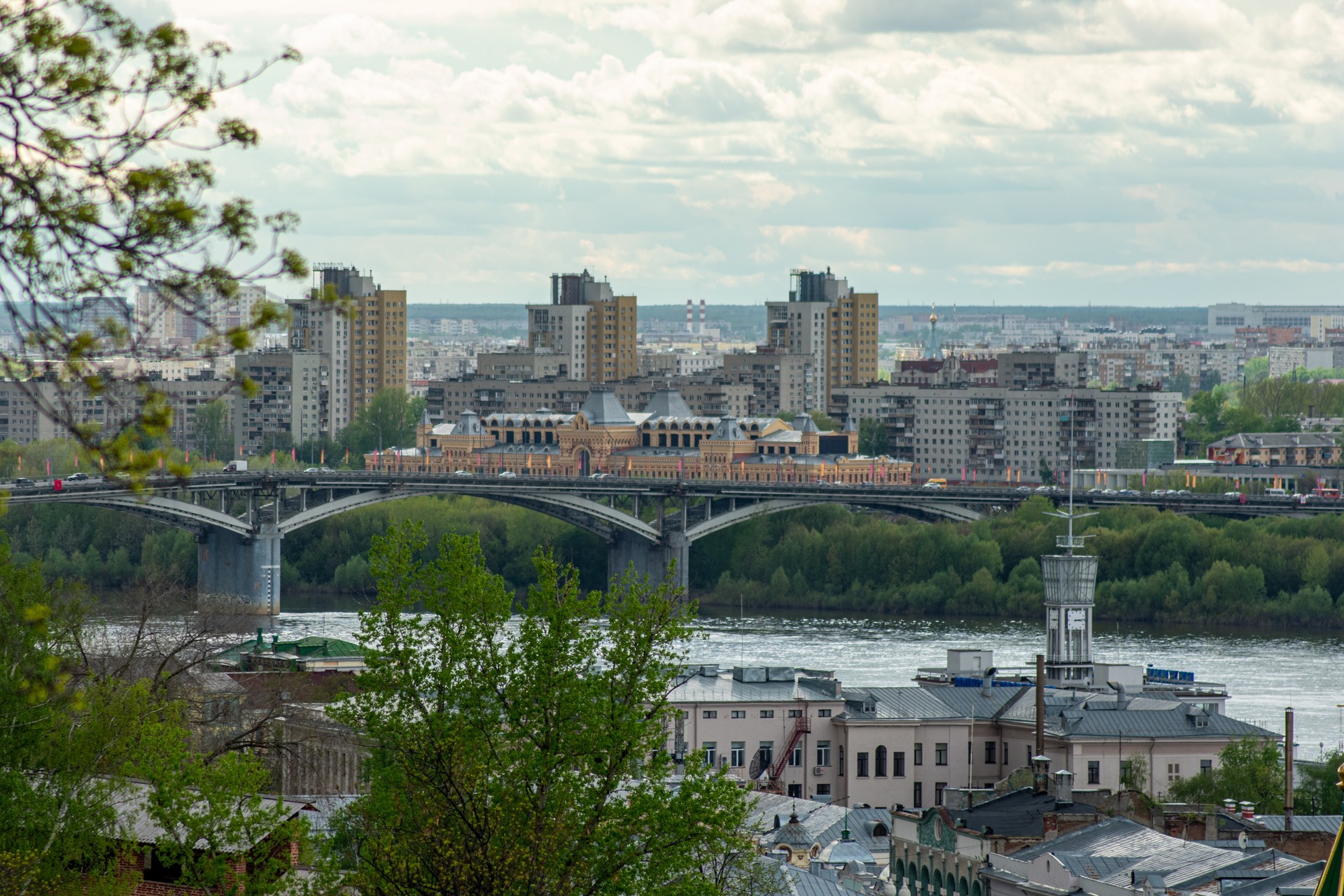
For a first trip, I would choose the Upper Town — the quarters around the Nizhny Novgorod Kremlin, Minin and Pozharsky Square, Bolshaya Pokrovskaya Street, the Upper Volga Embankment and Chkalov Staircase. Here it is easiest to understand the city’s topography: on one side are old streets and museums, on the other are the Volga panoramas that people come to Nizhny for.
Nizhny Novgorod stands where the Oka flows into the Volga, and this geography strongly affects the choice of area. If you stay in the centre, you can walk through the Kremlin in the morning, go down to the embankments by day, and by evening find yourself at viewpoints without unnecessary transfers. The city’s structure itself helps with this: the historic core is more compact than it seems on the map, but the changes in elevation here are noticeable, so comfortable shoes matter more than being close to any one particular point.
If you need a guide for your first day, build your route like this: Kremlin — Chkalov Staircase — Upper Volga Embankment — Bolshaya Pokrovskaya Street. This is a cluster of places that quickly makes it clear whether you like staying in a busy centre or whether it is better to look for quieter quarters slightly to the side. Before the trip, it is useful to look at the general destination page Nizhny Novgorod to estimate logistics by area.
Historic centre: the Kremlin, Pokrovka and museums nearby
The main area for those who want to stay in the centre of Nizhny Novgorod is the quarters around the Nizhny Novgorod Kremlin. The Kremlin is not only walls and towers, but also a convenient starting point: from here it is easy to reach Minin and Pozharsky Square, the Chkalov Monument and the descent to the embankments. Inside and around the Kremlin, it is convenient to start the morning while there are still few people and the outline of the high bank is clearly visible.
Nearby runs Bolshaya Pokrovskaya, a pedestrian street where it is pleasant to walk without a specific goal: to look at facades, go into courtyards and make short stops at museums. It is also convenient to stay here for those who like going out on foot in the evening rather than returning by transport from another part of the city. But it is worth understanding the downside too: the most central quarters are noisier, especially at weekends and during city events.
Among the museums in this area, people usually visit the Nizhny Novgorod State Art Museum and the Rukavishnikov Estate. The art museum is good not only for its collection, but also because it fits conveniently into a walk through the upper part of the city. The Rukavishnikov Estate gives a different view of Nizhny — merchant-style and ceremonial, with interiors after which the old embankments and mansions are understood differently.
If you want greenery in the centre, it is worth heading to Alexandrovsky Garden. This is an old park on the slope above the Volga, where the city’s difference in levels is especially strongly felt: above are streets and mansions, below the river opens up. For those choosing areas of Nizhny Novgorod as a tourist, this is an important clue: the centre is beautiful, but not exactly flat, and short routes here easily turn into long ascents and descents.
The Strelka and Nizhny Novgorod Fair area: for those who care about river views
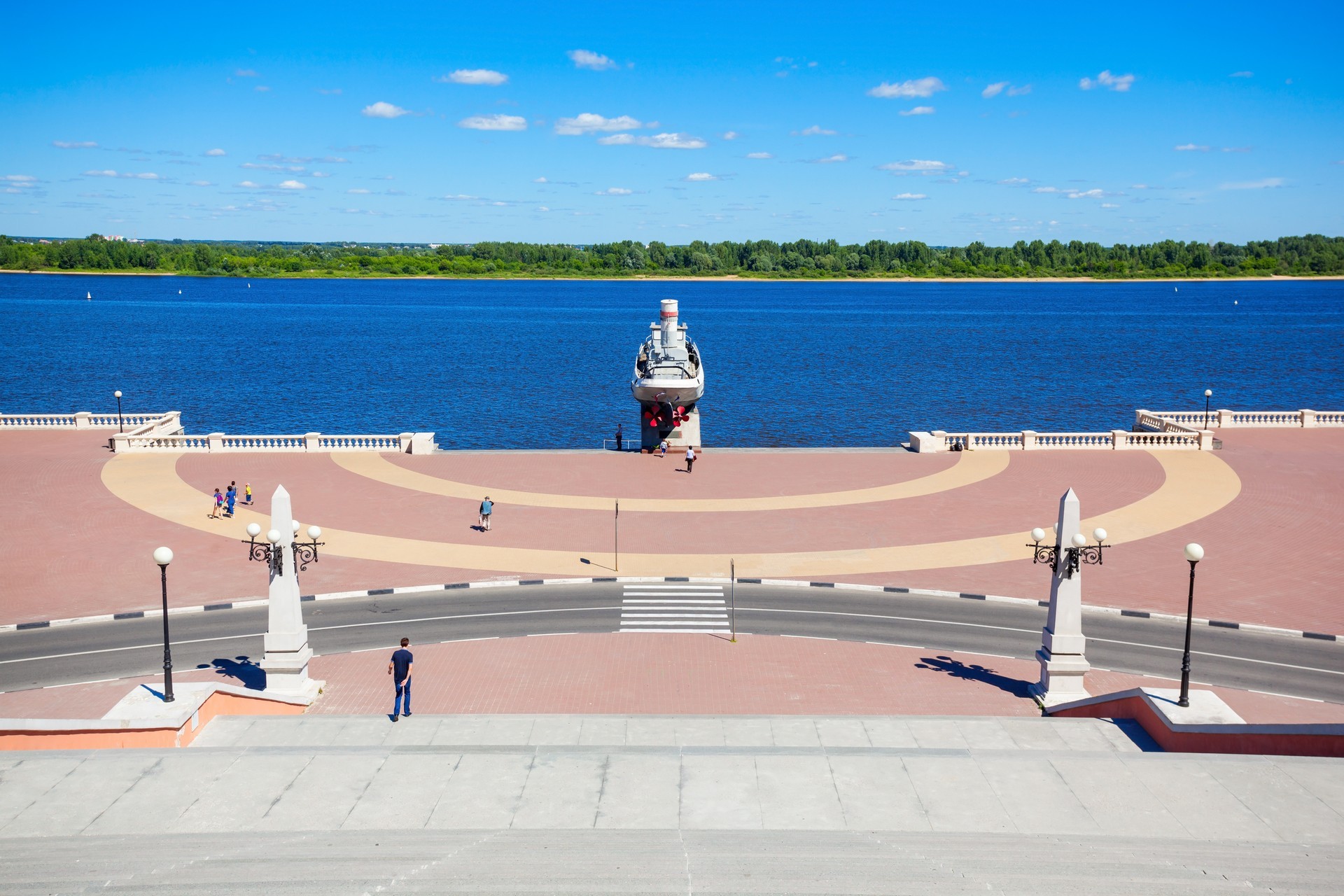
If the Upper Town is about old streets and the Kremlin silhouette, then the Strelka area shows a different Nizhny. Here the Oka flows into the Volga, and it is from here that you can especially clearly see how the city is laid out along the banks. It is worth coming to Strelka without rushing, closer to evening: the light becomes softer and the panorama deeper.
The main point of the area is Alexander Nevsky Cathedral. It stands in an open space and neatly gathers the whole river landscape around it. Nearby is the territory of the Nizhny Novgorod Fair, important for understanding the city: for a long time Nizhny lived not only as a fortress on a high bank, but also as a trading hub on the water. It is in this area that it becomes especially clear why the city is called many-sided: there is less intimacy of old streets here and more space, wind and wide views.
Staying nearby is convenient for those who want to combine walks in the centre with trips to the river and do not mind using transport more often. You can walk from here to the main elevated viewpoints, but the route will be longer than from the Upper Town. On the other hand, the area suits those who like more open spaces, modern public areas and panoramas without dense development.
If you have time left, add a crossing through the Kanavino part of the city to the embankments and back to the centre. A route like this helps you feel the difference between the upper and lower tiers of Nizhny Novgorod better than any tour.
Embankments and viewpoints: where to walk in the evening
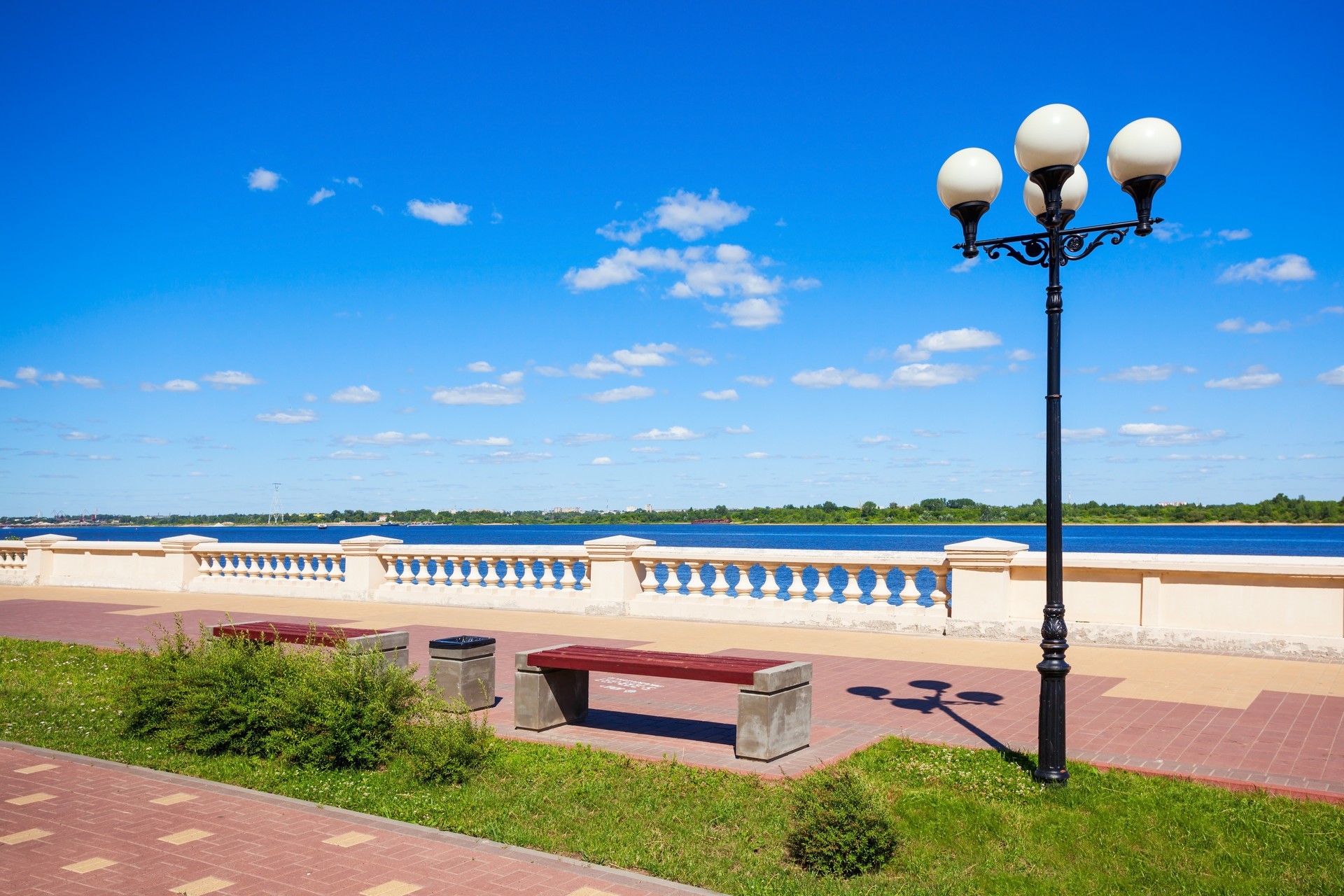
For evening walks in Nizhny Novgorod, I always have two favourites: the Upper Volga Embankment and Fedorovsky Embankment. The first is more ceremonial, with a long line of houses and openings to views of the Volga. The second is quieter and, to my taste, more expressive in panorama: from here the slopes, the lower part of the city and the course of the Oka are easy to read.
Chkalov Staircase is an important link between the upper bank and the lower walking levels. Even if you do not go all the way up or down, it is worth coming here for the perspective over the Volga. On postcards, Nizhny often looks solemn, but on the spot what is remembered more is precisely the combination of wind, wide space and the long lines of the bank.
Another place not to miss is Rozhdestvenskaya Street. It lies below the Kremlin heights and gives a different pace to a walk: merchant houses, old facades, churches and exits to the river. From here, it is convenient to build a route to the Annunciation Monastery — one of the city’s oldest monasteries, which fits well into a walk through the lower part of the centre.
If you are thinking where in Nizhny Novgorod it is best to stay for walks without taxis, then use the chain “Kremlin — Pokrovka — Upper Volga Embankment — Fedorovsky” as your guide. The closer you are to this axis, the easier it is to walk in short but packed outings instead of wasting energy on transfers between banks and tiers.
Where to go if you have come for more than two days
Once the centre has been covered, Nizhny has good half-day and full-day outings. The first option is Shchyolokovsky Khutor. This is a forest-park area with a museum of wooden architecture, where a city trip suddenly becomes almost a countryside walk. People come here for the quiet, wooden churches and houses, and also for the feeling that the big city has stepped back for a while.
The second option is Switzerland Park. It stretches along the high bank of the Oka and works especially well as a long walking route. Here there are not so much “must-see sights” as a good way to change rhythm after the dense centre and see the city through a green slope and the river.
If you want an old small town, it is worth going to Gorodets. It is usually chosen for its wooden carving, museum routes and Volga provincial atmosphere, which is very different from a large regional centre. Another interesting trip is the village of Diveyevo with its monastery ensemble; people go there for a more focused, non-urban atmosphere. Both destinations are best planned as a separate day.
Another option for nature lovers is Lake Svetloyar. This is no longer a city walk, but a calm trip for the sake of forest, water and an unhurried route around the shore. If you would rather stay closer to the urban fabric, you can simply walk longer along the embankments and watch how the character of Nizhny changes from the Kremlin heights to the fair lowlands.
Practicalities: when to come, what to bring and how much to budget
The most convenient months for a first trip are late spring, summer and early autumn, when you walk a lot and daylight lasts longer. In winter, Nizhny is also expressive: the Kremlin, staircases and high banks look graphic, but the wind from the Volga and Oka feels stronger than the temperature suggests. In the shoulder seasons, it is worth allowing time for slower walks: slopes, staircases and embankments after rain require attention.
Among your things, comfortable shoes, layered clothing and light wind protection are essential. Even on a warm day, viewpoints can be draughty, especially by the water. If you plan lots of museums and long walks across the upper and lower levels of the city, take a small backpack and water: routes often turn out longer than they look on the map.
For the budget, use this guide: the main walks around the centre require almost no spending, apart from cafes and museums. For museum entrance tickets and short trips around the city, it is reasonable to allow approximately 1,000 to 3,000 RUB per day per person on top of accommodation; if you add a trip out of town, the amount will rise depending on transport and programme. For Nizhny itself, it is best to allow 2–3 days, and with Gorodets, Diveyevo or Svetloyar — 4–5 days.
Where to stay
If you need the most central option for walking, take a look at “Rest Home” — the hotel is 250 m from the centre, and prices start from 1,200 RUB. Useful points include free parking and wi-fi.
A little farther from the very core of the centre is “Tari”: about 1,010 m to the centre, price from 2,500 RUB. This is a convenient option if you want to stay close to walking routes without being in the noisiest location.
For quieter accommodation, you can look at “Tikhiy Dvorik” — approximately 3,270 m from the centre, with prices from 2,600 RUB. It suits those who plan to alternate walks with returning to a less lively area.
Another option is “Beketoff”, about 3,990 m from the centre and a price from 2,800 RUB. If you are arriving by car, you can also consider “Max Royal”: it is farther from the centre — 8,380 m, but there is parking, a cafe, wi-fi, and pets are allowed; prices start from 3,055 RUB.
How to choose an area without making a mistake
If you are in Nizhny for the first time and want to see the main sights on foot, choose the historic centre and the upper part of the city. If river views, space and walks to Strelka matter more, you can look at the fair area and the adjoining quarters, understanding that you will have to get to the Kremlin and the upper embankments more often. And if you prefer a calmer rhythm, it makes sense to stay a little farther from the centre, but with a clear route out to the Kremlin and Pokrovka.
The main thing in Nizhny Novgorod is not simply to stay closer to a point on the map, but to fall into the rhythm of the city that suits you. Some people need a morning Kremlin and evening Pokrovka, others long walks along the embankments, and others trips to Gorodets, Diveyevo or Svetloyar. If you take into account the topography, the two rivers and the difference between the upper and lower city, choosing an area will be much easier.
Frequently asked questions
For long walks, late spring, summer and early autumn are more convenient. At this time, it is more comfortable to walk along the embankments, staircases and viewpoints. In winter the city is also impressive, but it can be windy on the high banks.
For a first visit, it is better to allow 2–3 days. This is enough for the Kremlin, the centre, the embankments, Strelka and several museums. If you want to add trips to Gorodets, Diveyevo or Lake Svetloyar, it is more sensible to plan 4–5 days.
The most important thing is comfortable shoes: the city has many climbs, staircases and long walking links between the upper and lower levels. A windbreaker or light outer layers, water and a small backpack are useful. By the rivers, the wind feels stronger than in the depths of the quarters.
No special preparation is needed, but it is worth taking the topography into account. The historic centre is located at elevation, and many interesting points are linked by staircases and descents to the embankments. If you do not want to get tired, it is better to alternate walking routes with short trips by transport.
If we are talking only about walks, museums and transport around the city, allow roughly 1,000–3,000 RUB per day per person on top of accommodation. The amount depends on the number of museums, cafes and taxi rides. Trips out of town to Gorodets, Diveyevo or Svetloyar increase the budget.
People fly into the city via Strigino Airport, and it is also convenient to arrive by train and intercity buses. For a short trip, the train is usually the most predictable option in terms of arrival time in the centre. If you come by car, it is worth taking into account heavy traffic in the central quarters and parking specifics.